
How to Recognize Bias in the Media
The media is an incredibly powerful tool that shapes many of the narratives we see on current events and issues. What can we do as the audience to make sure we are using unbiased resources when educating ourselves?
- Who are the sources? (.gov, .edu, .org vs .com, .net)
- News stories often use “official” sources like people from the government, big companies, or research groups. But they don’t always include the voices of regular people who are most affected.
- Anonymous sources can also be tricky! There are many reasons why someone would want to anonymously share their story, but reporters should explain the reason in a brief manner to maintain credibility.
- Who is telling the story?
- It matters who is reporting the news. Generally, news media that use moderators and invited guests are more biased compared to reporters reporting directly from the field. Are the reporters from different backgrounds? Are they including people from the communities being talked about? Stories are better when they include different points of view.
- Where is the funding from?
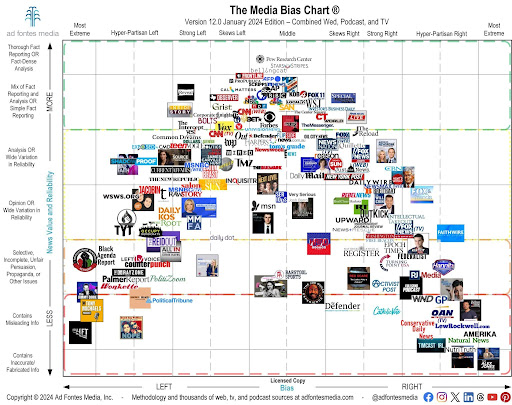
- Some news companies are owned by rich people or big businesses. This can affect what stories they tell or how they tell them. Even though reporters should stay fair, money and power always influence the message. Most people accept at face value to follow the money. It’s just as important to do the same with the media we trust.
- News sources that are based upon advertisements, subscriptions, donations, and sponsorships tend to represent a particular point of view. Special interest groups give money to support specific journalists, media personalities, bloggers, news stories, and think tanks. These are organizations that study and share ideas about different public policies.
- Some think tanks support conservative ideas, like limited government, free business, absolute freedom, and a strong military. Examples include the Heritage Foundation, Hoover Institute, Cato Institute, and American Enterprise Institute.
- Other think tanks support more progressive or liberal ideas. They focus on things like progressive economics, social justice, and liberal foreign policy. Some examples are the Brookings Institute, Center for American Progress, Economic Policy Institute, and Center on Budget and Policy Priorities.
- Special interest groups also help create ways to spread their ideas, like TV stations, websites, and social media pages.
- Does this story include loaded language?
- The words we use are important. Some words are chosen to make you feel happy, scared, or angry. These are called “loaded words.” Be careful when a story uses loaded words. Ask yourself if it’s trying to change your opinion instead of just giving facts.
- Buzzwords, often used in politics, can also trigger a bias about a particular side on an issue.
- Does it treat both sides the same, even when it shouldn’t?
- Sometimes, news gives equal time to both sides of a story, even if one side is based on misinformation or bias. This can confuse people and make false ideas seem normal. It can also make normal ideas seem false. Fair news means telling the truth clearly, not pretending both sides are always the same.
- What’s wrong with this picture?
- Photos and graphs can be powerful, but they can also be misleading. They frequently have confusing labels on their axes. Sometimes, the caption for a photo won’t actually match what’s in the photo. A chart may look like it shows something important, but it leaves out key details.
- Example: “In 2016, the New York Times reported that employment rates for white Americans were dropping, while rates for Black, Asian, and Hispanic Americans were rising. The Times’ chart misled by omitting key context: The main reason for the difference is that the number of working-age whites had fallen, while the number of working-age people in the other groups had risen.” (cite source)
- Do the headlines and stories match?
- Headlines are often written by someone other than the reporter. Some headlines can be misleading to get more clicks. This is clickbait. Don’t bite.
- Example: In The Christian Science Monitor, a staff writer titled the article, “With predator populations rising, more calls for control. Western states grapple with how to address an increasing threat to livestock from wolves and big cats.” In the article, “you will find that only predator populations specifically mentioned to be rising are cougars in Oregon and wolves in the Northern Rockies, and the text is quite balanced between those who worry about it and those who want to protect these large carnivores.” (Maughan)
SOURCES
- https://fair.org/take-action-now/media-activism-kit/how-to-detect-bias-in-news-media/
- https://www.unicef.org/eca/stories/quick-guide-spotting-misinformation
- https://www.cyber.gc.ca/en/guidance/how-identify-misinformation-disinformation-and-malinformation-itsap00300
- https://www.tradoc.army.mil/social-media-fake-news/
- https://www.thewildlifenews.com/2008/01/20/example-how-headline-does-not-match-story/
- https://www.getcybersafe.gc.ca/en/resources/recognize-artificial-intelligence-ai-9-ways-spot-ai-content-online
- https://guides.library.harvard.edu/newsleans/thechart